



What affects home extension costs on the Gold Coast?
Extension pricing depends on much more than the size of the new room. The way the addition ties into the existing home usually has a huge influence on cost.

When people start planning an extension, they often focus on the floor area they want to add. In reality, cost is shaped just as much by structural complexity, access, roof connections, service relocations, and how well the new work blends with the original home. A well-planned extension can add significant space and value for less than the cost of moving — but only if the early planning accounts for the parts you can't see.
Ground-floor vs second-storey: a key cost decision
The first question that shapes your budget is whether to build out or build up:
- Ground-floor (out) extensions are generally simpler and cheaper per square metre — new footings, slab or subfloor, walls, and a roof tie-in. The main constraints are block size, setbacks, and how much yard you're willing to give up.
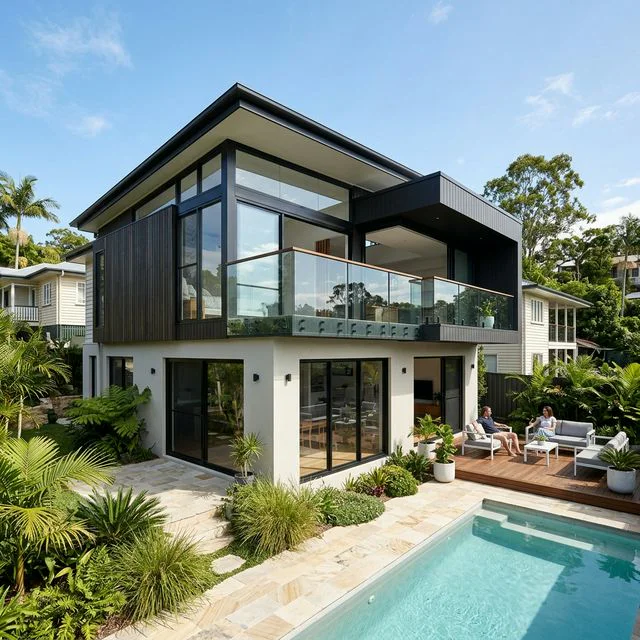
- Second-storey (up) additions avoid losing yard and suit tight inner-city Brisbane and beachside Gold Coast blocks, but they cost more: the existing structure and footings often need strengthening, a staircase has to be worked into the floor plan, and the home usually needs to be made weather-tight stage by stage while you live in it.
On a sloping site, building in underneath an existing raised home — common with Brisbane Queenslanders — can be one of the most cost-effective ways to add a whole level.
Structural tie-ins can be one of the biggest cost factors
Rear extensions, side additions, and second-storey projects all need to connect properly to the existing structure. Footings, wall removals, beam requirements, and roof alterations can all influence engineering and build complexity. Because these tie-ins are builder's work and need engineering and approval, they're where DIY-style estimates most often fall short. Getting a licensed builder to assess the existing structure early tells you quickly whether your plan is straightforward or whether it needs upgraded footings and beams.
Access and site logistics matter
On tighter Gold Coast and Brisbane blocks, moving materials and coordinating trades can be harder than people expect. Limited side access, sloping sites, and established landscaping can all affect how efficiently the work can be delivered — and slower, more manual site logistics show up directly in labour costs. Where a crane or restricted access is involved, it pays to plan the build sequence carefully.
Approvals and overlays
Most extensions need building approval, and many need development approval as well, particularly if you're extending the footprint, going up a storey, or working on a home in a character, heritage, or flood overlay. These overlays are common across inner Brisbane and parts of the Gold Coast. Factoring approval time and any town-planning requirements into your timeline early avoids costly delays once you're committed.
Matching the old and new home takes planning
- Rooflines, eaves, windows, and cladding details all affect the finish quality — a good extension looks like it was always part of the home.
- Material matching can be straightforward or surprisingly difficult depending on the age of the home; older brick, render, and timber profiles aren't always still available.
- Services like plumbing and electrical, and sometimes the switchboard or hot water system, may need to be extended or upgraded to support the new area.
Frequently asked questions
Is an extension cheaper than moving?
Often, yes — once you account for stamp duty, agent fees, and moving costs, extending to get the space you need in the home and suburb you already love can be the better financial decision.
Can I live in the home during the extension?
Usually yes, especially for ground-floor extensions. Second-storey work and major structural stages can be noisier and more disruptive, but a staged build plan keeps the home liveable through most of the project.
How long does an extension take?
It varies widely with scope, but many extensions run a few months on site after design and approvals. We give you a projected timeline as part of the planning phase.
If you are planning to add space, our home extensions service explains how we approach structural planning, material matching, and builder-led delivery — and for whole-home projects, see our Brisbane renovations and Gold Coast renovations pages.
.webp)